
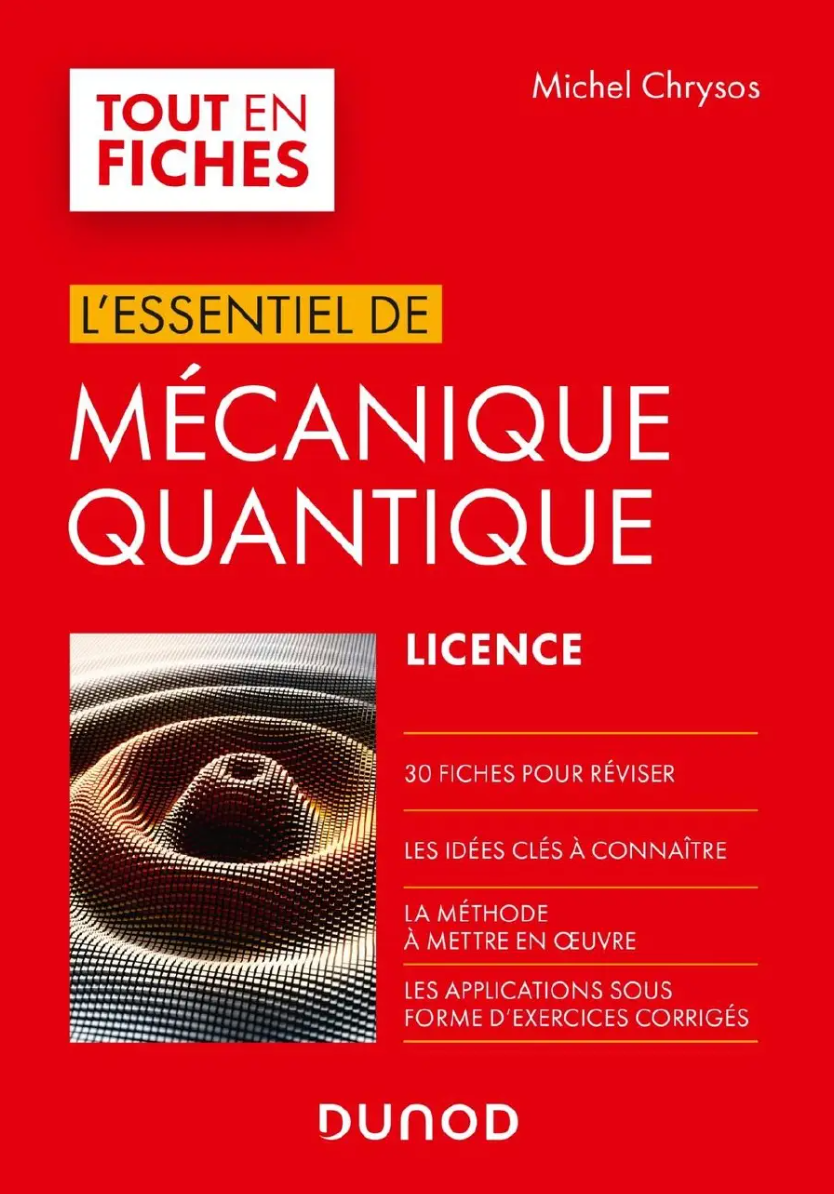
Exploring Quantum Mechanics: A Comprehensive Guide
Quantum mechanics, the branch of physics that deals with the behavior of particles at the atomic and subatomic levels, has revolutionized our understanding of the universe. “Mécanique Quantique – Tout en Fiches” is a concise yet thorough resource designed to introduce and explain the fundamental concepts of quantum mechanics. This guide is particularly beneficial for students pursuing a bachelor’s degree in physics, offering clear explanations and practical examples to facilitate learning.
Detailed Overview of the Guide
“Mécanique Quantique – Tout en Fiches” is structured into thirty comprehensive sections, each focusing on a specific aspect of quantum mechanics. The guide begins with an introduction to the core principles, such as the wave-particle duality and Planck’s constant, setting the foundation for more complex topics. Subsequent sections delve into various phenomena and mathematical frameworks, including the Schrödinger equation, the uncertainty principle, and the concept of quantum states.
The guide is tailored for undergraduate students in physics, providing a clear and accessible approach to quantum mechanics. Its structured format, with each section building upon the previous one, ensures a logical progression through the material. The inclusion of numerous examples and exercises enhances comprehension and allows readers to apply theoretical concepts to practical scenarios.
In-Depth Analysis of Key Concepts
Wave-Particle Duality
One of the foundational concepts in quantum mechanics is wave-particle duality, which posits that particles such as electrons exhibit both wave-like and particle-like properties. This duality is exemplified in the double-slit experiment, where particles create an interference pattern characteristic of waves, yet individual detections occur as discrete particles.
Schrödinger Equation
The Schrödinger equation is a fundamental equation in quantum mechanics that describes how the quantum state of a physical system changes over time. It is central to understanding the behavior of particles and is instrumental in predicting the probability distributions of particles’ positions and momenta.
Uncertainty Principle
Formulated by Werner Heisenberg, the uncertainty principle states that certain pairs of physical properties, like position and momentum, cannot both be precisely known simultaneously. This principle challenges classical notions of determinism and introduces a fundamental limit to measurement precision in quantum systems.
Quantum States and Superposition
Quantum states describe the state of a system, encompassing all information about the system’s properties. The principle of superposition allows a system to exist in multiple states simultaneously until an observation or measurement is made, leading to the collapse of the system into one of the possible states.
Entanglement
Quantum entanglement is a phenomenon where particles become interconnected in such a way that the state of one particle instantaneously influences the state of another, regardless of the distance separating them. This phenomenon has been experimentally verified and is a cornerstone of quantum theory, with implications for quantum computing and cryptography.
Quantum Tunneling
Quantum tunneling refers to the phenomenon where particles have a probability of passing through a potential barrier, even if they do not possess enough energy to overcome it classically. This effect is crucial in various physical processes, including nuclear fusion in stars and the operation of tunnel diodes in electronics.
Quantum Mechanics and Classical Physics
The guide also explores the relationship between quantum mechanics and classical physics, highlighting how quantum mechanics extends and refines classical theories. It discusses the limitations of classical physics in explaining phenomena at the atomic and subatomic levels and how quantum mechanics provides a more accurate and comprehensive framework.
Context and Background of the Author
The author of “Mécanique Quantique – Tout en Fiches” is a seasoned physicist with extensive experience in both theoretical and experimental physics. Their expertise is evident in the clarity and depth of the explanations provided in the guide. The author has contributed to various academic publications and has a background in teaching quantum mechanics at the university level, making them well-equipped to present complex concepts in an accessible manner.
Critical Reception and Impact
Since its publication, “Mécanique Quantique – Tout en Fiches” has been well-received by both students and educators. Its structured approach and comprehensive coverage of quantum mechanics have made it a valuable resource in academic settings. The guide’s emphasis on practical examples and exercises has been particularly appreciated for enhancing student engagement and understanding.
Why You Should Read This Guide
For students embarking on the study of quantum mechanics, this guide offers a clear and concise introduction to the subject. Its structured format and inclusion of practical examples make complex concepts more accessible. Educators can also benefit from the guide as a supplementary resource to support teaching and provide students with additional practice materials.
In comparison to other quantum mechanics textbooks, “Mécanique Quantique – Tout en Fiches” stands out for its brevity and focus on essential concepts, making it an excellent starting point for those new to the field. Its practical approach ensures that readers not only understand theoretical principles but also develop the skills to apply them in various contexts.
Conclusion
“Mécanique Quantique – Tout en Fiches” serves as an invaluable resource for anyone interested in understanding the fundamental principles of quantum mechanics. Its clear explanations, structured approach, and practical examples make it an essential tool for students and educators alike. By engaging with this guide, readers will gain a solid foundation in quantum mechanics, preparing them for further study and exploration in the field.